
Can You Get Professional Video Quality Without a Crew?
Aug 12, 2024Yes. The two things that read as professional to a viewer are light on your face and clean sound, and both are settled by the room and the setup rather than by the size of the crew. What a crew still buys you is location work, multiple angles and someone else running the day.
What actually makes a video look professional?
Three things, and a viewer registers all three before you have finished your first sentence. Whether your face is lit. Whether the sound is clean. Whether the person talking can hold a thought without drifting.
Two of those are physical. Get the light and the microphone right once and they stay right, because a desk does not move and a room does not change its mind. The third is the one nobody budgets for, and it is the one that separates a video people finish from a video people close.
Heather Hukins, Managing Director of H4 Consulting, found the limit was never the camera:
“The weakest link in our filming wasn't me, it was the environmental noise that kept interrupting our takes.”
Traffic, a doorbell and the bin truck. None of that is a quality problem a bigger camera solves.
So why does video people shoot themselves usually look worse?
Because it gets assembled once and never settled. Gear bought piece by piece off a forum recommendation. A window used as the key light, which works until three in the afternoon. A laptop microphone sitting a metre away from your mouth, pointed at the ceiling. A slightly different arrangement every time, so every recording starts with twenty minutes of fiddling before a word is said.
The pattern Ridge sees most often in people who bought their own kit is not bad footage. It is unused footage, because the setup cost enough friction that the recording stopped happening. That is a workflow failure wearing a quality costume.
An installed desk studio removes that by fixing the variables in place: the camera, the lighting, the microphone and the recording path are specified, built and tested before they reach your desk, and then they stop being a decision. If you want the split between what is handled for you and what stays yours, that is answered in done for you or do it yourself.
What can a crew do that a desk setup cannot?
Plenty, and it is worth being straight about it.
- A desk studio cannot leave the desk. Site work, a factory floor, a client's office, an event: that is a crew job.
- It cannot put three people in shot, or move a camera through a space, or shoot a product on a set.
- It cannot direct you. A good crew brings someone whose whole job is telling you the take was flat and asking for another one.
- It cannot carry the schedule. Someone else booking the day and turning up is a real service, and some people genuinely need it.
If that list describes what you are actually buying, hire the crew. The mistake is not choosing a crew. The mistake is choosing a crew because you assume the quality only comes with one, and then making four videos a year.
If quality is not the difference, what is?
Frequency, and it is not close.
One polished video a quarter loses to one decent video a week, because the thing that builds trust is being seen repeatedly, not being seen perfectly. Someone who has watched you eight times arrives at a call already half sold. Someone who has watched one beautifully graded brand film has met a production company, not you.
That is where the economics turn over. Heather's first package of training videos paid for the entire setup in a single sale, and H4 Consulting now delivers to government and public-sector clients without flying to the room. A crew priced per project cannot get you there, because every video restarts the cost.
So which one should you actually pick?
Work out which constraint is binding before you compare anything on picture quality, because picture quality is the one thing all three options can get right.
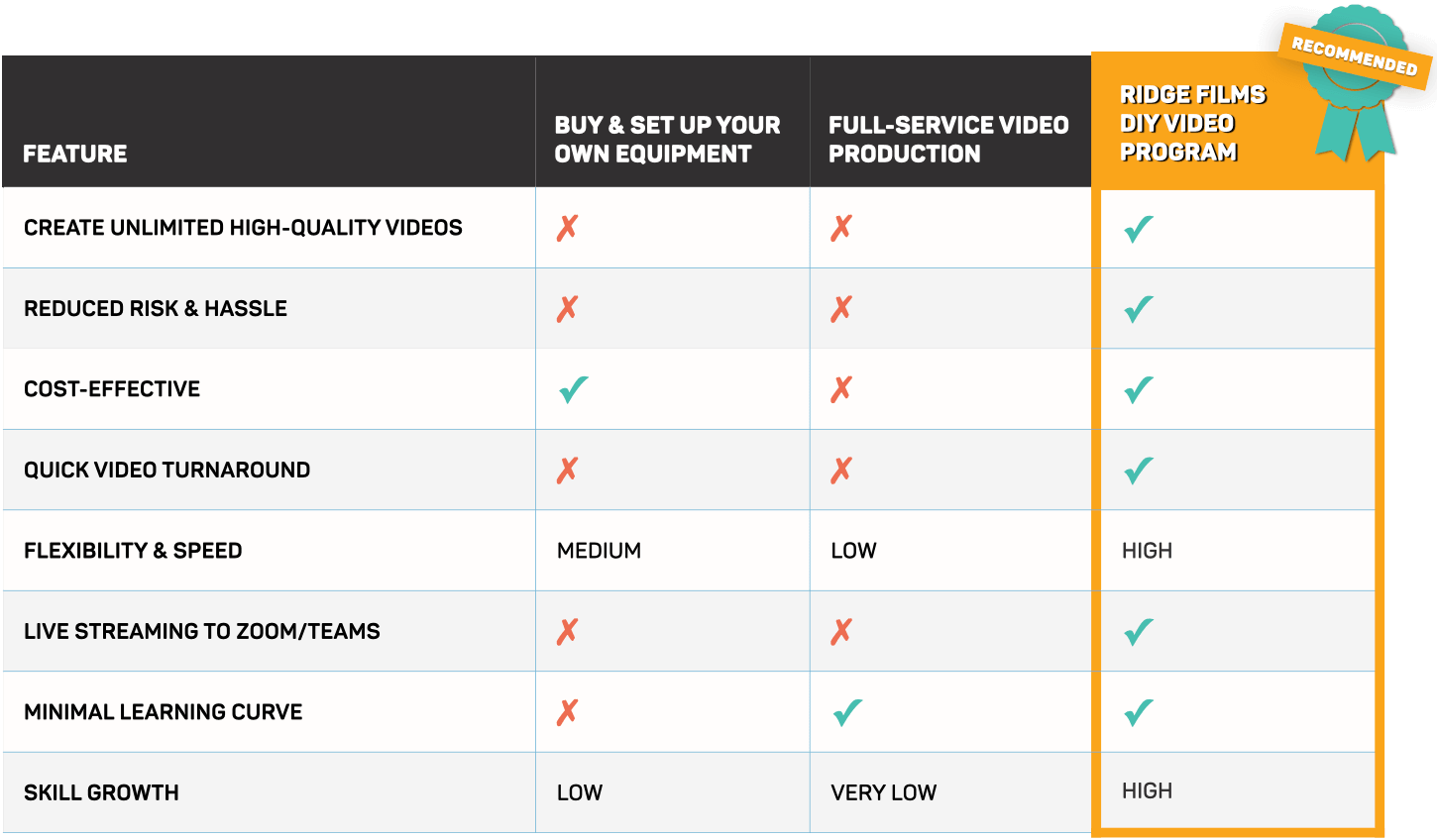
If the binding constraint is that video has to happen away from your desk, hire a crew. If it is that you want to spend as little as possible up front and you genuinely enjoy the tinkering, buy your own gear. If it is that you need to be on camera often, and the setup is what keeps stopping you, a fixed studio is the only one of the three that makes that realistic. The full three-way trade, including where a desk studio loses, is in buy gear, hire an agency, or do it yourself.
And whichever you pick, the gear is the easy pillar. Messaging, on-camera performance and actually implementing it are the harder three, which is why Ridge sells coaching alongside the studio rather than as an upsell after it. More on where video fits before you buy anything: why video matters for your business.
Common questions
Does a desk studio really match the quality of a professional crew?
On a talking-head video recorded at a desk, yes. Light, sound and framing are fixed once at install and do not vary between recordings. A crew still wins on anything that needs location, movement, multiple people in shot or a set, because those are not quality problems, they are production problems.
Will buying better equipment fix my video quality?
Usually not on its own. Equipment is one of four pillars, alongside messaging, on-camera performance and implementation, and it is the easiest of the four. A better camera pointed at an unlit face in a noisy room produces a sharper version of the same problem.
What can a Desktop Studio not do?
It cannot leave the desk, it cannot direct you, and it cannot make you press record. The most common reason a studio underperforms is not the hardware, it is that nobody built the habit of using it, which is why coaching sits alongside the install.
How much does a Ridge Films Desktop Studio cost?
The Desktop Studio is one fixed price covering the equipment, the build, the installation at your desk and the coaching that goes with it. Payment plans are available, and a plan figure is not the price of the studio. The current figure is on the Desktop Studio page, which is the page that keeps it up to date.
Ready to work out which one you actually need?
Bring your situation and Chris will tell you straight whether a studio is the right answer for it, including when it is not.